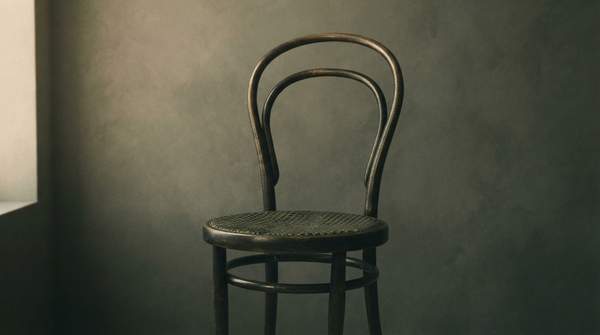
When you settle into a café chair with a gently curved back and slender, sweeping arms, you are sitting inside an idea that began with Michael Thonet in the 1850s. His breakthrough—bending solid wood with steam rather than carving it or gluing veneers together—did more than produce elegant seating. It established a design principle, that a single continuous bent line could form a chair's structure, and that principle carried directly into the next great material shift in furniture: the bent tubular steel of the modernists.
The Dawn of Bentwood: Michael Thonet's Innovation
Before Thonet, furniture followed heavy, straight lines. Chairs were carved from solid timber or assembled from stacks of veneers glued together—craft-intensive methods that constrained form and cost. According to the Victoria and Albert Museum, Thonet spent years bending wood made of glued veneer stacks before making his key technological breakthrough in 1855: by adding steam and attaching a metal strip along the wood's length, solid wood could be bent in a similar way.
This was not a marginal improvement. The museum notes that the steam-bending process was cheaper than working with laminated veneers, and it earned Thonet patents that guaranteed him a virtual monopoly on production. The German-Austrian cabinet maker had made his first bentwood chair in Vienna in the 1850s, and after nearly another decade of development, he established the family firm Gebrüder Thonet in 1853.
What made the technique so durable, literally, was what happened inside the wood. As furniture retailer Trent Furniture explains in its historical account, Thonet perfected the method of using steam to soften the wood, bending it into the desired shape, and then leaving it to cool and dry back into a completely solid form. The fibers were coaxed into a curve rather than cut through it, preserving the material's integrity while freeing it from the straightness that had defined furniture for centuries.