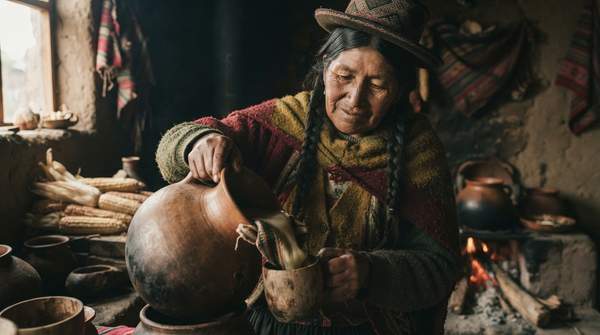
Traditional chicha is made by germinating maize, cooking the germinated grain, and letting the mash ferment naturally. That deceptively simple sequence produced far more than a drink: in the pre-Columbian Andes, and above all in the Inka empire, chicha was a ceremonial offering, a political instrument, and a daily sign of hospitality. If you want to understand Andean civilization, you could do worse than follow a kernel of corn from the field to the drinking vessel.
Chicha: An Ancient Andean Legacy
Chicha de jora, the emblematic corn-based version of the drink, is described in a scientific overview of the beverage as one of the most emblematic traditional beverages of the Andean world, produced through maize germination, followed by cooking and spontaneous fermentation. The result was a beverage traditionally associated with nutritional, functional, and recreational attributes—and those characteristics, the same overview notes, conferred profound cultural and ceremonial significance within Pre-Columbian Andean civilizations, particularly under the Inca Empire, known as Tawantinsuyu, in ancient Peru.
The drink's roots run deep. An educational project on chicha's origins points to pottery in the Andean region from around 5000 B.C., with archaeologists who study those sites suggesting the vessels were likely used to carry and store chicha. The same account observes that, like cacao elsewhere, chicha became a cultural signifier for many Andean groups—a marker of identity rather than a mere refreshment.
The Profound Cultural and Social Roles of Chicha in the Inka Empire
In pre-colonial societies, chicha served as a ceremonial beverage; it maintained societal bonds, toasted ancestors, and invoked the supernatural, according to reporting in American Indian Magazine. This was not casual drinking. The beverage was a medium through which the living connected with the dead and the divine.
Within the Inka empire, the drink acquired an explicitly political dimension. An order of chosen virgin women, known as the Acllas, were responsible for ritual duties, including cultivating sacred maize and preparing chicha for imperial consumption. This beverage was central to the Inka's efforts to reinforce the social hierarchy through ceremonial feasts and both political and religious events. The Sapa Inka, or their representatives, journeyed across the empire to offer invitations for these drinking occasions—a gesture whose direction held significant meaning. The invitation always flowed from superior to inferior; it was a token of favor carrying an attached indebtedness. Toasts between lords and vassals, the same account notes, carried the significance of treaties. A shared gourd of chicha could bind a province to the empire as surely as a signature on parchment.