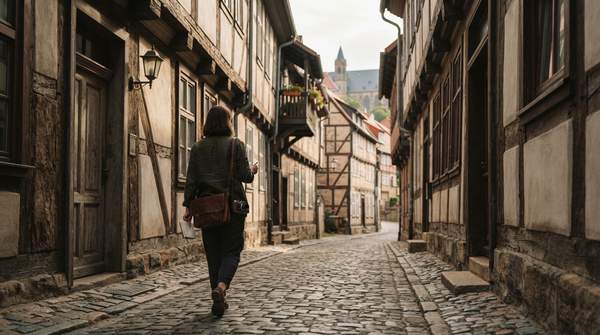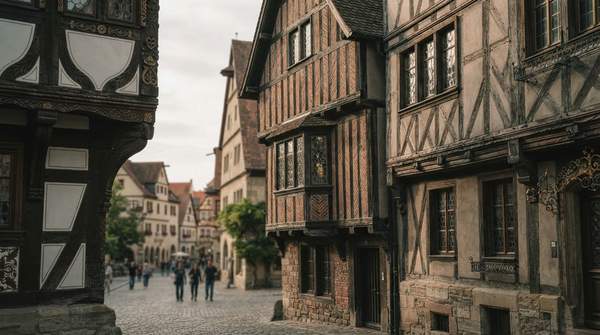
Half-timbering is one of the world's oldest construction techniques, and once you understand its logic, you can read its regional accents at a glance. The method is simple at heart: a rigid cage of squared wooden timbers carries the building, and the spaces between the timbers are filled with something cheaper and heavier—brick, clay, or plaster. What changes from country to country is the handwriting. Germany's Fachwerk favors bold, braced frames; England's Tudor "black and white" manors turn their timbers into intricate crisscrossed patterns; and France's colombage, especially in Normandy, stains its beams dark and arranges them into striking geometric façades. This article explains the structural principles underneath all three, then gives you a comparative reference for telling them apart.
The Enduring Principles of Half-Timbered Construction
Every half-timbered building begins with its skeleton. Traditionally, the frame was made of squared oak timbers joined by mortises, tenons, and wooden pegs—no nails required. The result, as the Encyclopaedia Britannica describes it, is a "cagelike structural skeleton," often strengthened at the corners with braces. The timbers do the structural work; the infill merely closes the wall.
That division of labor is what makes the style so adaptable. The same pegged framing method served both low, rambling country homes and six- or seven-storied buildings in crowded medieval towns. The infill varied with whatever was locally available: brick, plaster, or wattle and daub in England; in France, brick or a clay mixture such as torchis, a cob made from lime, chopped straw, and animal hair, as Elinor Sheridan explains in her survey of French half-timbered houses. In Picardy, brick largely replaced cob between the frames, reflecting a strong Germanic influence on the region's architecture.
The technique is ancient. Sheridan traces it back to the Roman Empire, noting that it gained popularity in France during the Middle Ages before stone-based construction displaced it. Britannica records that it was used for domestic architecture throughout northern continental Europe, especially Germany and France, until the 17th century, and in England from roughly 1450 to 1650, particularly in the southern counties and the West Midlands, where stone was scarce.