The Japanese tea ceremony, chanoyu, is not fundamentally about tea. It is a ritual in which four philosophical concepts—wabi cha, yu-gen, geido, and satori—transform the preparation and drinking of a bowl of tea into a mindful, aesthetic, and spiritual discipline. Understanding these four ideas is the key to understanding why the ceremony looks and feels the way it does, and why its practitioners treat every gesture as meaningful rather than procedural.
The Japanese Tea Ceremony: A Path to Mindful Practice
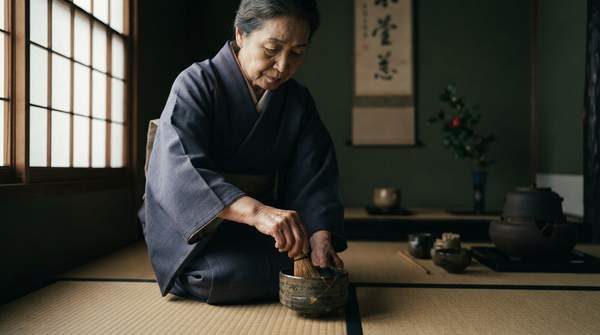
Chanoyu emerged in the fifteenth and sixteenth centuries, during Japan's samurai-dominated medieval age, as Iris Mustafina explains in her account of the ceremony's evolution for the Japan Society. Powdered green tea is scooped into a large bowl and whipped into a frothy, bitter drink with hot water from a kettle. What distinguished the ceremony from ordinary tea drinking was the development of rules—codified procedures for preparing, serving, and consuming tea that separated the ritual from the mundane act.
That codification is precisely where philosophy enters. The ceremony is often described as a form of meditation, engaging all five senses—taste, touch, sound, smell, and sight—simultaneously. Yet it is worth being precise: although chanoyu has deep roots in Zen Buddhism, it does not have to be a Zen practice, and for many practitioners historically and today, it is not. The philosophy is spiritual in character, but the practice is not exclusively religious.
Historical Roots: From Zen to Wabi-Sabi
The ceremony's philosophical vocabulary developed over centuries. In the thirteenth and fourteenth centuries, the Japanese aristocracy held lavish tea-tasting parties called tocha, in which guests competed to identify different teas. But the stronger thread ran through Zen Buddhism: in the fourteenth and fifteenth centuries, monks incorporated tea preparation and the simplicity of everyday actions into their spiritual practices.
The Muromachi period, roughly 1336 to 1573, saw the rise of Higashiyama culture, centered on Ashikaga Yoshimasa's retirement villa in Kyoto's eastern hills. This era is generally regarded as the period in which Japanese traditional culture as it is known today took shape, and in which the use of tea developed into a "transformative practice" with its own aesthetic—particularly the principles of wabi-sabi. It was also in this period that philosophies like wabi-sabi, beauty in imperfection, and ichi-go ichi-e, "one time, one meeting," began to be conceptualized, turning the ceremony into a ritual aimed at crafting a singular, unrepeatable moment of hospitality.