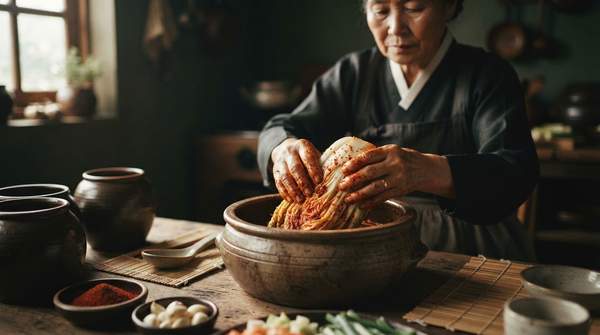
Kimchi is not a recipe so much as a managed ecosystem. What began in ancient Korea as salted vegetables packed into jars for winter survival has become, through centuries of refinement, one of the world's most sophisticated fermented foods — a dish whose safety, sourness, and shelf life are produced by a predictable succession of bacteria that traditional preparation methods deliberately cultivate. I want to show you how the history and the microbiology are two halves of the same story: the practices Korean communities developed empirically turn out to be precise controls over an invisible microbial process.
The Ancient Roots of Kimchi: From Simple Pickles to Cultural Icon
The earliest evidence points to fermentation as ordinary daily practice, not delicacy. The Samguk Sagi, a historical record of the Three Kingdoms of Korea, mentions the pickle jar used to ferment vegetables, indicating that fermented vegetables were commonly eaten in that era; the Goguryeo people were skilled fermenters who widely consumed fermented food. These early forms — simple salted vegetables, primarily cabbage and radish — were essential for food security during harsh winters, when fresh produce simply was not available.
The dish most of the world recognizes today is far younger than the technique. Chili peppers, the source of the red gochugaru seasoning, arrived only after the seventeenth century, and their adoption was a genuine turning point: they gave kimchi its vibrant color and characteristic spiciness, transforming its sensory identity. As a narrative review of kimchi's history published in a scholarly journal notes, the origin and evolution of kimchi are intrinsically linked to Korea's history, with techniques and ingredients adapting to diverse regional and social environments over time.
That evolution eventually earned formal international standing. The Codex Alimentarius Commission stipulated an international standard for kimchi in 2001, and kimjang — the traditional Korean communal activity of making kimchi together — was listed as UNESCO Intangible Cultural Heritage of Humanity in 2013. As food scientists at the University of Georgia observe, a preservation method once rooted in centuries-old Korean tradition now appears on mainstream grocery shelves far beyond Korea, in an expanding range of regional styles and flavor profiles.