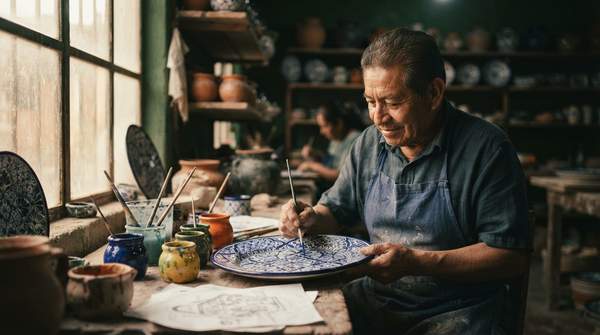
A piece of authentic Talavera pottery is not simply Spanish pottery made in Mexico. It is a legally defined craft in which Spanish technique, Moorish pattern, Chinese-inspired color, and indigenous Mexican symbolism are fused under a certification regime that Mexico has enforced since 1997. The tradition is centered on Puebla and the surrounding volcanic soils, and since 2019 the process itself — not merely the finished object — has been recognized by UNESCO on its Representative List of the Intangible Cultural Heritage of Humanity. Learning to "read" a piece means tracing each design choice back to its source.
The Blended Heritage of Talavera Pottery
Talavera's name comes from Talavera de la Reina, the central Iberian town that became internationally renowned for ceramics in the 15th and 16th centuries. Yet the Mexican tradition that carries its name today developed its own distinct identity over four centuries. As Madeline Enriquez explains in a Talavera La Catrina account of the craft's history, the designs reflect many influences at once: Spanish and European styles, Moorish geometric details, Chinese porcelain, and the rhythm and symbolism of indigenous and local artisans.
That blending is precisely what gives the tradition its meaning. The designs changed again after Mexican independence from Spain in 1821, when new glaze colors — red, yellow, green, black, and orange — joined the traditional blue and white. Flowers, birds, suns, moons, hearts, cacti, and folk imagery became common alongside older colonial designs, making Talavera what Enriquez calls a living art form rather than a frozen historic relic.
Spanish and Moorish Roots: Techniques and Patterns
Spanish artisans brought two foundational techniques to Mexico: the potter's wheel and tin-glazing, the majolica earthenware method that gives Talavera its lustrous painted surface. According to Sarah Teel, writing for an art history exhibition at Missouri State University, these techniques were taught to indigenous Mexican peoples as part of broader Spanish efforts to convert them to Christianity — which is why early motifs typically depicted biblical events and images of saints such as the Virgin Mary.
The decorative grammar runs even deeper into Iberian history. As the Wikimedia-contributed history of the craft records, techniques and designs of Islamic pottery arrived in Spain with the Moors by the end of the 12th century, as Hispano-Moresque ware. Enriquez notes that Moorish-inspired geometric details, floral scrolls, and decorative borders persist in Talavera designs today, layered alongside religious and European imagery.