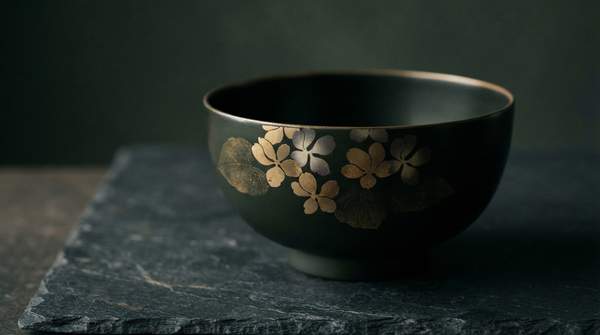
Japanese lacquerware, known as urushi, is built in two distinct acts: a long, largely invisible process of layering and polishing lacquer sap into a durable, lustrous surface, and a second act of decoration in which gold powder, mother-of-pearl, or carved lines transform that surface into imagery. Understanding this structure — foundation first, ornament second — is the key to distinguishing the major techniques, such as maki-e, raden, and chinkin, and to recognizing how regional traditions like Kanazawa's Kaga maki-e and Aomori's Tsugaru Nuri gave each method its own character.
The Enduring Artistry of Japanese Lacquerware (Urushi)
Urushi is the craft of coating objects — bowls, boxes, trays — with lacquer derived from the lacquer tree. What makes the material remarkable is its versatility: as specialists at Musubi Kiln describe, urushi functions not only as a coating but also as a pigment and an adhesive. That triple role is what allows a single substance to serve as both the smooth, protective body of a vessel and the "glue" that fixes gold powder or shell into its surface. Japanese artisans drew on these qualities to develop a family of surface decoration techniques, collectively known as kashoku, which lend lacquerware its heightened artistic expression.
Before any decoration appears, however, the piece must be built. Accounts of the foundational process describe it as painstakingly incremental: artisans apply dozens of layers of lacquer, curing each one, and sand the surface repeatedly between coats. One artist's general account of the work describes sanding the lacquer down to a thickness measured in hundredths of a millimetre — a figure that conveys the precision involved rather than a fixed specification. This is slow, humid-conditioned work, and it is the reason a finished piece carries its characteristic depth and luster. It is worth stressing that these are practitioners' summaries of the process rather than a comprehensive technical guide; the exact composition of base layers and the specific polishing tools vary by workshop and tradition.
The craft's reach has long extended beyond Japan. Traders once commissioned Kyoto artisans to apply maki-e to Western-style furnishings such as cabinets and decorative boxes, and lavish combinations of maki-e with raden — mother-of-pearl inlay, then still rare in Japan — sold at high prices in Spain and Portugal. These pieces delighted European aristocrats and royalty, including Queen Marie Antoinette of France, as well as members of the Christian clergy. The tradition of cross-cultural admiration continued into the present: in 2023, a contemporary Kyoto-based lacquer artist, Asai Yasuhiro, had a work added to the collection of the British Museum.