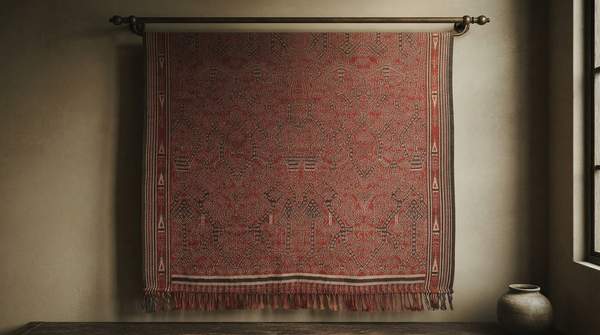
Among the Iban people of Sarawak, Malaysia, the pua kumbu is far more than a decorated textile. It is a ritual cloth that accompanies a person through every threshold of life—wrapped around a newborn at its first bathing rites, draped over a couple in marriage, and present at the end of life. Its creation is itself a spiritual undertaking: ethnographic accounts describe the designing, dyeing, and weaving of pua as the female equivalent of male headhunting, a parallel path to prestige and power. Understanding this cloth means understanding both a demanding, ritualized craft process and the cosmology it serves.
The Sacred Art of Pua Kumbu: An Introduction
The pua kumbu is a patterned cloth made by the Iban, the largest indigenous group of Sarawak, using the resist-dyeing technique known as ikat and a backstrap loom. What distinguishes it from ordinary weaving is not technique alone but the framework that surrounds it. A study of the textile's aesthetic formation, published in the Journal of Ethnic and Diversity Studies, finds that its motifs, spatial composition, colour symbolism, weaving techniques, and ritual protocols are governed by culturally regulated principles rooted in Iban cosmology, ancestral reverence, and spiritual authority.
In other words, the cloth is not free personal expression. The same study observes that Iban aesthetics prioritise moral responsibility, relational legitimacy, and collective validation over individual artistic autonomy. A weaver inherits designs and obligations; she does not simply invent. This is why the pua kumbu functions as a sacred object rather than a decorative one, and why its patterns and dye recipes are treated, as one craft account notes, as the weaver's guarded intellectual property.
The 'Women's Warpath': Spiritual Significance of Weaving
The most striking framing in the ethnographic record comes from a review of John G. Kreifeldt's Woven Power: Ritual Textiles of Sarawak and West Kalimantan, written by Jeffrey B. Spurr. In that account, the very act of pua designing, weaving, and dyeing was considered the female equivalent of male headhunting—an equal contribution to the viability of society. Both pursuits, Spurr explains, were understood as critical acts in the service of a positive relation to the spirit world and to the future welfare of the population, instantiated in such concrete goals as achieving a good harvest.
This equivalence gave weaving genuine social weight. The scholarly volume Enriching Iban Pua Kumbu frames the tradition around the place of female weavers in Iban society and the significance of Indigenous knowledge for community development, alongside the origins, symbolism, and use of the cloths. The weaver's status was earned through mastery of a dangerous craft: the mixing of mordant baths—known as indu' takar and indu ngar—could, according to the craft documentation, only be performed by select women because of cultural taboos. Skill in this domain was a form of spiritual authority, not merely technical accomplishment.