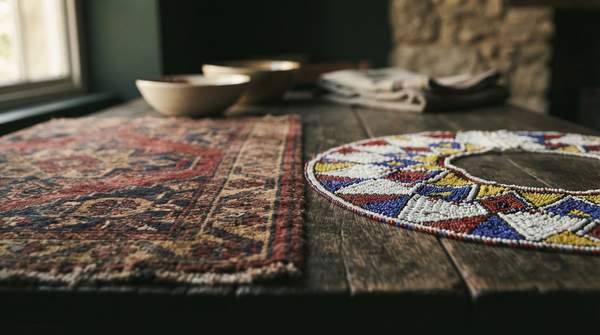
The same hue rarely says the same thing twice. In hand-knotted carpets from China's Xinjiang region, red is a statement of prosperity and vitality; in Zulu beadwork from South Africa, red speaks of love—but also anger and heartache. Yellow, which the Zulu vocabulary treats with striking ambivalence, appears only marginally in the color sample of Xinjiang's pomegranate motifs. These two craft traditions, separated by continents, show how color functions as a genuine language rather than mere decoration.
The Silent Language of Color in Traditional Crafts
The scholarly foundation for this comparison comes from a study of Xinjiang handmade carpets by Kaige Lin and Jiu Zhou, published in Humanities and Social Sciences Communications, which adopts a framework combining cultural semiotics and material culture studies. Their premise is that colors operate as "complex sign systems that convey cultural meanings and social values," embedded in the chromatic language of the carpets.
African textile writers describe the same idea in warmer terms. Eva Sonaike, a designer writing on African color traditions, frames the continent's colors as narrators of "traditions, histories, and identities" across peoples including the Yoruba, Ashanti, Berber, and Zulu. For Zulu beadwork specifically, Alice Guzman, writing for the craft retailer Africa Direct, notes that the tradition is "a language unto itself, with each color and pattern carrying significant meaning," used as a means of communication, expression, and identity.
Color Symbolism in Chinese Xinjiang Carpets
Lin and Zhou's analysis centers on plant motifs, with the pomegranate as its richest case. Analyzing 306 color samples from pomegranate motifs, they found red and orange dominant, at 46.4 percent and 20.9 percent respectively, with blue at 9.8 percent; yellows, greens, cyans, and purples occurred only minimally, between 0.7 and 2.9 percent.
Within that palette, the meanings are affirmative and communal. Red symbolizes prosperity and vitality, aligning with Uyghur hospitality and resilience; orange conveys warmth and harvest; blue signifies serenity and nobility. The authors note that these hues harmonize with the appearance of ripened pomegranates, and that although the application differs from Central Plains textiles, Xinjiang's red pomegranate motifs share roots in traditional Chinese color culture, collectively expressing aspirations for harmony and abundance.
The Expressive Hues of South African Zulu Beadwork
Zulu beadwork built its vocabulary through history: Guzman records that early beads were made from natural materials such as seeds, bones, and shells, and that the introduction of European glass beads in the nineteenth century raised the craft's intricacy. What distinguishes the Zulu system is its polarity—each color carries both a positive and a negative register, and context decides which one speaks.
According to Ithemba Creations' account of the Zulu "love letter" tradition, blue stands for fidelity, or for loneliness, expressed in phrases like "I would fly the skies to be with you." Yellow means wealth and fertility, or jealousy and withering away. Ololade Oso, writing for the Ekiken blog, adds that red is a color of love that can also express anger and heartache, while white—worn by brides—symbolizes spiritual love and purity, and is the only color in the system that carries no negative meaning.
Comparative Color Symbolism in Traditional Textiles
The table below juxtaposes the two traditions, hue by hue. Read down the color column and the divergence becomes visible immediately: no single hue carries the same primary meaning in both systems, and only the Zulu tradition assigns a negative register to most colors.
| Culture / Region | Craft | Color | Symbolic meaning | Qualification |
|---|---|---|---|---|
| Chinese Xinjiang | Handmade carpets (pomegranate motifs) | Red | Prosperity and vitality | Aligned with Uyghur hospitality and resilience; the dominant color at 46.4% of samples |
| Chinese Xinjiang | Handmade carpets (pomegranate motifs) | Blue | Serenity and nobility | Appears at 9.8% of samples; a smaller but meaningful presence |
| Chinese Xinjiang | Handmade carpets (pomegranate motifs) | Orange | Warmth and harvest | Second most frequent at 20.9% of samples |
| South African Zulu | Beadwork | Red | Love; also anger and heartache | Ambivalent color with both positive and negative registers |
| South African Zulu | Beadwork | Blue | Fidelity; also loneliness | Loneliness expressed as "I would fly the skies to be with you" |
| South African Zulu | Beadwork | Yellow | Wealth and fertility; also jealousy and withering away | Dual positive and negative readings |
| South African Zulu | Beadwork | White | Spiritual love and purity | Worn by brides; the only color with no negative meaning |
One honest gap deserves mention: the Xinjiang study's evidence does not assign a specific symbolic meaning to yellow beyond its minimal frequency in the pomegranate palette, so no direct comparison of yellow symbolism across the two traditions is possible here. What the juxtaposition does establish is that red and blue—the two hues documented in both traditions—carry fundamentally different freight in each. Xinjiang's red speaks to communal aspiration; Zulu red maps emotional states, from love to heartache. Xinjiang's blue evokes calm nobility; Zulu blue describes a relationship's fidelity, or its lonely absence.
The two systems also work differently. Zulu beadwork encodes polarity within single colors, and arrangements add a second layer of meaning: Ithemba Creations records that black beside white represents marriage, red beside black an aching heart, and blue with white a conventional engagement symbol. The Xinjiang carpet vocabulary, by contrast, works through motif and frequency, letting dominant hues express sustained cultural values—harmony and abundance—rather than personal circumstances.
Textiles as Cultural Narratives
Why does color carry such weight in these objects? The semiotic framing offered by Lin and Zhou treats carpet colors as sign systems conveying social values, not aesthetic choices alone. The African evidence points the same direction from the practitioners' side: Sonaike, whose writing reflects her own design practice and influences, treats African textiles as vehicles that carry woven narratives of identity, and Guzman records beadwork's explicit function as communication, expression, and identity among the Zulu.
In both traditions, then, the craft object is a text. A Xinjiang carpet's red pomegranate field reads as an aspiration to prosperity rooted in traditional Chinese color culture; a Zulu bracelet's blue-and-white beads read as a proposal. The reader who learns to read either one is no longer looking at decoration, but at a sentence written in thread and glass.
Understanding Cultural Nuances in Textile Symbolism
When interpreting traditional textiles, recognize that color meanings are culturally specific and can carry dual positive and negative connotations. The simplest test of that principle: pick a single hue—red—and watch it change voice. In the pomegranate motifs of Xinjiang handmade carpets, red stands for prosperity and vitality; in Zulu beadwork, the same color expresses love alongside anger and heartache. Any reader who can articulate that one difference has grasped the essential lesson of both traditions, and the yardstick for reading any other textile they encounter.
Sources
- Color rules and cultural connotation of Chinese Xinjiang handmade carpets — Nature
- Exploring Symbolism & Colours in African Textiles and Cultures — Eva Sonaike
- A Kaleidoscope of Culture: Exploring the Rich Heritage of African Zulu — Africa Direct
- The Zulu Love Letter — Ithemba Creations
- Beads That Speak: The Hidden Language of Zulu Beadwork — Ekinken