Japanese woodblock printing reached its artistic peak not through a single genius but through a division of labor: a publisher with overall control, an artist who drew the design, a carver who cut the blocks, and a printer who pressed each color onto paper. The Victoria and Albert Museum describes this team as the "ukiyo-e quartet," and its collaborative structure is inseparable from the art form's technical history. Over roughly a millennium, the craft moved from monochrome printing in the eighth century to the full-color "nishiki-e," or brocade pictures, developed in 1765—a progression driven as much by the tastes of a newly wealthy merchant class as by innovation in carving and registration.
The Enduring Art of Japanese Woodblock Printing
Woodblock printing arrived in Japan during the eighth century and, according to an account published by Friends of Aomori, became the primary method of printing from the eleventh to the nineteenth centuries. For most of that long span, the technique served text and image reproduction in simple, single-color form. What transformed a utilitarian printing method into a celebrated art was the distinctive style, perspective, and craftsmanship that developed in Japan—a style that became known as ukiyo-e, or "images of the floating world."
The technical process that matured during the Edo period (1615–1868) remains in use today, and its demands are considerable. As the Friends of Aomori feature notes, making a traditional woodblock print "is intricate and requires an intense amount of concentration, accuracy, and skill." That intricacy explains why no single artisan could produce a finished print alone. Each color required its own carved block, and aligning those blocks precisely on a single sheet of paper demanded coordination among specialists who each spent years mastering one stage of the workflow.
Understanding a Japanese woodblock print therefore means reading it two ways at once: as an image, and as the visible record of a production system. The color complexity of a print reveals its historical moment; the crispness of its lines reveals the carver's hand; the evenness of its tones reveals the printer's. The sections that follow trace the technical evolution first, then the cultural world that consumed the prints, and finally the step-by-step collaboration that produced them.
Key Stages in Japanese Woodblock Printing Evolution
The clearest way to grasp a thousand years of development is to sequence its milestones chronologically. The table below orders the major technical and stylistic shifts, mapping the progression from single-color printing to the multi-color sophistication of the late Edo period.
| Date/Period | Key Development | Description |
|---|---|---|
| 8th century | Introduction of woodblock printing | Woodblock printing came to Japan during the eighth century and became the primary method of printing from the eleventh to the nineteenth centuries. |
| Late 17th century | Emergence of ukiyo-e | The genre of "pictures of the floating world" arose, depicting popular subjects for the merchant class, initially as monochrome prints (sumizuri-e). |
| Early 18th century | Early color techniques | Monochrome prints began to receive additional colors applied by hand (kappazuri-e). Two registration marks carved into the blocks, called "kento," proved especially helpful once multiple colors had to be applied with precision over previous ink layers. |
| Circa 1765 | Full-color nishiki-e | The ukiyo-e style developed into full-color "brocade pictures" (nishiki-e), allowing intricate multi-color designs and marking the peak of technical sophistication. |
| Early to mid-19th century | Peak color complexity | By the time of Hokusai and Hiroshige, ukiyo-e prints were produced with up to twenty different colors, virtually each requiring its own carved block. |
Two turning points in this sequence deserve emphasis. The first is the kento registration system: as the crowd-sourced encyclopedia of Japanese woodblock printing explains, the sheet of paper to be printed is placed into the kento and then lowered onto the woodblock, allowing successive colors to land in exact alignment. Without this humble carved guide, multi-color printing at scale would have been impossible. The second turning point is the arrival of nishiki-e around 1765, when the growing popularity of ukiyo-e created demand for ever-increasing numbers of colors and complexity of techniques—and the workshop system delivered it.
Ukiyo-e: Pictures of the Floating World
The word ukiyo-e literally means "pictures of the floating world," but the floating world was a specific place, not a poetic abstraction. According to the Victoria and Albert Museum, it referred to the licensed brothel and theatre districts of Japan's major cities during the Edo period—inhabited by courtesans and Kabuki actors, and serving as the playgrounds of the newly wealthy merchant class. The prints produced in their many thousands depicted scenes from everyday Japan, and they were hugely popular precisely because they could be produced cheaply and in large numbers.
This economy of production had a striking social consequence. Even with their low standing in the rigid social structure of the era, actors and courtesans emerged as prominent trendsetters, and their styles disseminated widely among the populace through affordable woodblock prints. A painting by a leading artist was affordable only to the wealthy; a print of the same celebrity culture cost little enough to reach a wide audience. The ukiyo-e style, as the V&A dates it, developed in 1765 and remained popular until the closing decades of the Meiji period (1868–1912).
The commercial logic worked both ways. The merchant class wanted images of the floating world's stars, and that demand pushed publishers to commission designs of ever greater color and compositional ambition. As Khan Academy's account of the genre notes, artists were constantly trying to outdo one another—not only with beautiful colors but also with clever compositions. Technical innovation and popular appetite advanced together, each feeding the other.
The Collaborative Craft: Roles of the Artisans
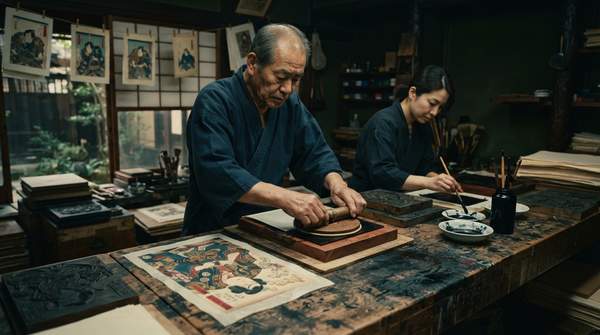
Traditionally, woodblock printing was a collaborative process between an artist, carver, printer, and publisher, as the Japanese Gallery explains. The publisher usually held overall control of the process, in the V&A's description of the "ukiyo-e quartet"—initiating designs, managing the specialists, and carrying the finished prints to market. The publisher's editorial and commercial influence over what got made was therefore considerable, even though the artist's name is the one most prints carry today.
The artist, or eshi, created the initial brush drawing, selected the colors, and determined their placement within the print. Once the design was complete, an exact copy was made and placed face-down on a block of cherry wood—a timber favored, as the V&A notes, for its fine, even grain and consistent density. The British Museum adds that because cherrywood is exceptionally hard, a few hundred copies could be made from each design before any significant loss of crispness or detail.
The carver, or horishi, then carved a relief into several wooden blocks—one for each color the artist had specified. Consolidated, these blocks would create a cohesive image, since a separate woodblock is required for each color in woodblock printing. The carver's skill determined whether the artist's brushwork survived translation into knife-cuts, and whether twenty separate blocks could still resolve into a single, aligned picture.
Finally, the printer, or surishi, worked seated on the floor at a low table called a suridai, angled downwards to prevent backache, as the British Museum describes. The printer applied each color in turn, registering the paper against the kento marks and pressing it onto its block. A print by Utagawa Kunisada from 1857, the museum notes, humorously depicts women at these various stages—unlikely in a real studio of Hiroshige's time, but accurate in showing the different steps of making an ukiyo-e print. The finished artwork was thus genuinely collective: the artist's conception, the carver's precision, and the printer's touch, held together by the publisher's control.
Understanding the Legacy of Ukiyo-e
To fully appreciate Japanese woodblock prints, recognize them as the result of a sophisticated, multi-century technical evolution and a highly collaborative artisanal process. Neither half of that statement can be separated from the other: the floating world's celebrity culture created the demand, and the kento registration system, hard cherrywood blocks, and quartet of specialists created the supply.
The measurable test of understanding is straightforward. The reader can identify the historical period of a print based on its color complexity and describe the distinct roles of the artist, carver, and printer in its creation. A single-color print points to the earliest stage; hand-applied color to the transitional eighteenth century; a full brocade of many colors to the nishiki-e era after 1765; and a print with a dozen or more hues to the age of Hokusai and Hiroshige, when up to twenty blocks might pass under one printer's hands before the image was complete.
Sources
- Japanese woodblock prints (ukiyo-e) — Victoria and Albert Museum
- Woodblock printing in Japan - Wikipedia — EN
- The Japanese Woodblock Printing Process — Friends of Aomori
- Client Challenge — Khanacademy
- Japanese Woodblock Printing Process — Japanesegallery
- Britishmuseum