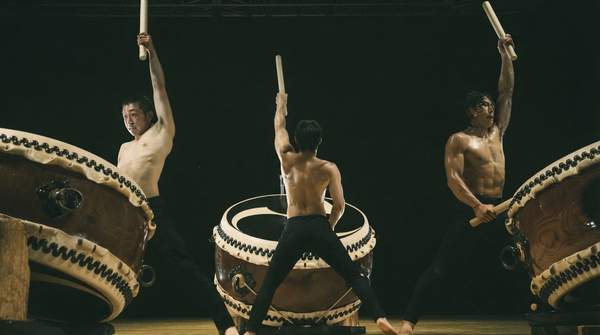
Taiko drumming has never been a single thing. Across roughly fourteen centuries in Japan, the same family of barrel drums has served as a voice for the divine, a signal in warfare, a timekeeper in imperial court music, an engine of village festivals, and, since the 1950s, a standalone ensemble art form. Understanding taiko means understanding those layers in sequence: the modern group performance audiences know today is a mid-20th-century invention, built on an instrument whose ritual roots stretch back to the 6th century and whose migration abroad made it a vessel of cultural identity for Japanese immigrant communities.
Ancient Echoes: Taiko's Ritualistic and Military Origins
Historical accounts trace taiko's arrival in Japan to Chinese and Korean cultural influence as early as the 6th century CE, with some instruments resembling those originating even farther away in India. Archaeological evidence supports the drum's presence in Japan during the Kofun period, including pottery from Haniwa figures depicting taiko drums. The earliest historical record cited in this connection dates to 588 CE, when young Japanese men traveled to Korea to study the kakko, a drum that originated in South China—an appropriation of continental instruments that may have shaped taiko's emergence.
What the earliest drums were for is the more revealing question. Taiko Center, a Japanese taiko organization, describes the ancient instrument as "a sanctifying instrument," suggesting that early people felt the power of deity in its rumbling sound. Typically, men authorized by a priest played taiko on special religious occasions, while common people joined in dancing. Alongside these ceremonial functions, historical records note the drums' use in communication and military action—roles that persisted until warfare itself moved beyond the drum's reach.
From Court to Stage: Taiko in Classical Japanese Arts
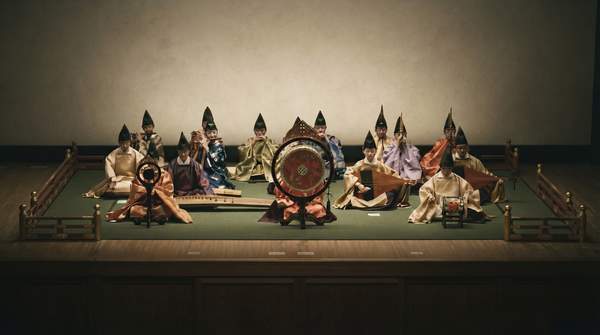
A decisive institutional moment came in 702 CE, when the Taiho Ritsuryo—described by Taiko Center as Japan's oldest constitution—was enacted and a department of imperial court music was established in the Imperial Palace. That department, according to the same account, has been inherited directly to the present day and is honored as an Important Intangible Cultural Asset. In gagaku, a classical music tradition typically performed at the Tokyo Imperial Palace, taiko sets the rhythm that guides traditional dance.
Theater absorbed the drum next. When the samurai class seized power in the Kamakura Period (1185–1333), Japan began developing a culture increasingly its own, and as theatrical forms such as Noh and Kabuki emerged in the following centuries, taiko became an important part of the storytelling. This integration marked a shift toward more structured artistic roles: the drum that once sanctified a ritual now served choreography, narrative, and ensemble coordination.