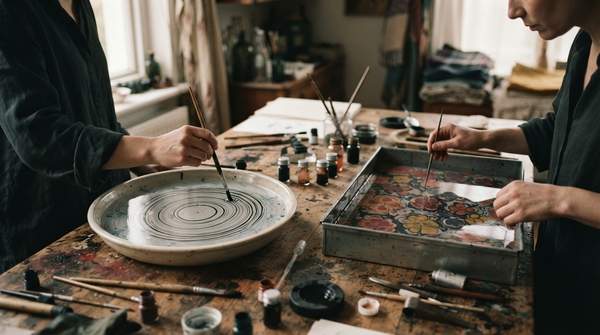
Traditional paper marbling grew from two distinct technical foundations. Japanese Suminagashi floats sumi ink on plain water and coaxes it into delicate, concentric patterns with breath or a fan. Turkish Ebru, and the Western marbling that descended from it, suspends water-based pigments on a bath thickened with size and draws them into intricate, controlled designs with styluses and combs. Understanding that single difference—plain water versus a thickened medium—explains nearly everything about how the two traditions look, and why European bookbinders embraced the latter.
Suminagashi: Japan's 'Floating Ink' Tradition
The name itself describes the method: "Suminagashi" means "ink-floating" in Japanese. In this technique, sumi inks are dropped into a shallow pan of plain water, where they remain on the surface. The ink is then moved across that surface by blowing on it or with a fan, and the paper is laid onto the ink briefly before being lifted away. The result is a pattern of naturally spreading rings and tendrils, shaped more by the physics of the water's surface than by any deliberate drawing.
What makes this possible is a small but crucial additive. A surfactant made of tree resin is dropped into the ink, and it is this substance—added to the ink rather than to the water—that helps the ink spread across the surface. Because the medium is plain water, the artist works with the ink's own tendency to expand and interact, intervening only gently. The patterns that emerge are correspondingly soft, fluid, and unrepeatable in their exact form.
Dating the tradition precisely is difficult. As rare-book writer Katie Behrens notes, paper does not survive the centuries the way stone or metal does, so no one is certain how old marbling truly is; historians generally agree it was practiced in Japan by the tenth century. One practitioner's account suggests the technique may be older still, originating in China over two thousand years ago and practiced in Japan from the twelfth century. The dates differ between accounts, but the sequence—East Asian origin, long Japanese practice—is consistent.
Ebru: The Turkish and Western Evolution of Marbling
Ebru, the Turkish tradition, rests on an entirely different physical arrangement. Water-based colors can only stay afloat on the surface of water heavily thickened by size, as the University of Washington's decorated-paper collection essay explains. The size, in modern Western practice, is made from carrageenan, a type of moss; before carrageenan, marblers used tragacanth, a natural gum. This thickened bath is what prevents water-based pigments from sinking, and it is the reason Ebru could develop in a direction Suminagashi never took.
Once the pigments float, they are manipulated with implements—styluses, rakes, or combs—during the window of time before they disperse. Design & Paper's history of the craft describes how, by the fifteenth century, Turkish artists had refined this into highly controlled approaches, using styluses, combs, and brushes to work the floating colors into intricate stone-like veins, feathered repeats, and even stylized floral motifs. The thickened bath stabilizes the pigments and allows deliberate pattern construction rather than gentle encouragement.
One further additive governs the paint's behavior. Ox gall, highly diluted with water, is added to the paints to control how far they spread on the size. An account from the Armagh Robinson Library describes the working setup: a level tray filled with size, paints dropped onto it according to the design, combs drawing them into specific patterns, and an absorbent paper surface laid on to capture the result. Western marbling, building on this foundation, developed a vocabulary of structured patterns that could be reproduced with relative consistency—which is precisely what made it suitable for commercial bookbinding.